
Detonation
ReadyFire Electric Detonators
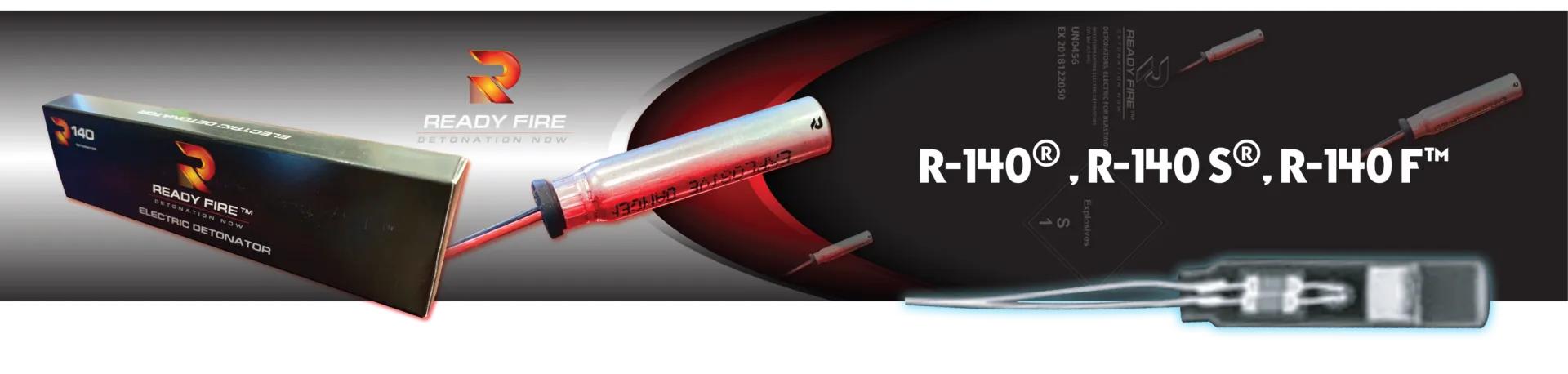
Reliable electric detonators engineered for consistent activation in demanding wireline operations — the R-140 family, built by PMR Global.
Our Story
Engineered for Reliability
In early 2019, under the leadership of John Rymell and David Sciuto, PMR Global saw a detonator market eager for diversification and consistent reliability. David Sciuto travelled overseas frequently to help develop an electric detonator superior to the ageing designs then in heavy use. That work evolved into the R-140® family — the R-140®, R-140S®, and R-140F™.
Designed with the most advanced internal components available today and built for accuracy and reliability — because cheap detonators only result in more failures, less profit, and a more dangerous work environment.
R-140S®, R-140®, and ReadyFire® are registered trademarks of PMR Global and are not to be used by any other company.

Proven in the Field
Unmatched Consistency You Can Count On
ReadyFire detonators are used by leading wireline companies making the switch to a reliable, consistently available source.
40,000+
Sold in the US with almost no failures
250,000+
Sold overseas, yielding consistent reliability
100+ yrs
Combined detonation experience
R-140
Family, including the R-140S
Specifications & Ordering
Available to Qualified Buyers
Download the ReadyFire brochure and spec sheet below. RDX and HMX options are available on request (MOQ TBD).
Prefer to talk it through? Call (817) 484-1100 and ask for David Sciuto.
Download the ReadyFire R-140S brochure & spec sheet (PDF)Safety & Compliance
Safety and Procedure Requirements
Quality can be compromised by several vital environmental factors that must be considered. Procedures must be followed by trained, ATF-certified professionals.
The following questions and procedures must be considered if a failure occurs:
- What procedure took place during the installation? (ATF-certified personnel)
- What control panel or initiation system was being used?
- Was it verified and tested before initiation?
- How were the guns sealed during delivery and wrapped for transportation to eliminate any chance of contamination — moisture, heat, wind, dust? Is there visual evidence?
- What were the external factors on the day of transportation or ignition? (Temperature, weather, etc.)
- Where were the detonators or loaded systems stored, and for how long?
- What was the hydrostatic pressure of the well?
- What was the well condition? (H2S, CO2, percentage of gas on the day of testing)
- What was the condition of the failed gun systems, both externally and internally? Visual proof is required to determine potential contamination.
- Was explosive decompression a possibility in the well environment?
Consistent & Reliable Detonation
Get locked in to a dependable source. Contact us about using or distributing ReadyFire.